Commercial air transport aircraft operating in Dutch Caribbean territory must adhere to the provisions of ICAO Annex 6 - Operation of Aircraft, Part I - International Commercial Air Transport - Aeroplanes, Chapter 6 (Aeroplane Instruments, Equipment and Flight Documents) and Chapter 7 (Aeroplane Communication and Navigation Equipment).
2.1. In addition to the above-mentioned, all aircraft operating within the Curaçao FIR, Aruba CTR and St. Maarten TMA, whereby the territory of the Dutch Caribbean is over flown, must adhere to the provisions detailed below in accordance with the type of flight.
Flights conducted between the BES Islands.
Radio and navigation equipment to be carried within the Curaçao FIR, Aruba CTR or St. Maarten TMA shall comply with the provisions of ICAO Annex 6 Volume 1 and 2, chapter 7 and article 14 of the Civil Aviation (air Navigation) Regulations, 1995 as amended.
On all internal flights and on flights with single-engine and multi-engine aircraft which are not capable of maintaining the prescribed minimum safe altitude in the event of engine failure, shall comply with the provisions of ICAO Annex 7 Chapter 7.8 and for Curaçao Civil Aviation Regulations CARNA Part 7, and the following emergency equipment shall be carried.
Each item of emergency and flotation equipment shall be:
- Readily accessible to the crew and with regard to equipment located in the passenger compartment, to passengers without appreciable time for preparatory procedures;
- Clearly identified and clearly marked to indicate its method of operation;
- Marked as to date of last inspection; and
- Marked as to contents when carried in a compartment or container.
- No person may operate an aircraft authorized to carry more than 250 passengers unless it has a properly installed medical kit for the use of the medical doctors or other qualified persons in treating in-flight medical emergencies.
- The installed medical kit shall contain the minimum contents specified in CARNA Part 7 IS: 7.8.1.3.
- No person may operate an aircraft unless it has the minimum number of portable fire extinguishers of a type which, when discharged, will not cause dangerous contamination of the air within the aeroplane. The type and quantity of extinguishing agent shall be suitable for the kinds of fires likely to occur in the compartment where the extinguisher is intended to be used.
- One properly installed in the pilot’s compartment; and
- At least one portable fire extinguisher shall be provided and conveniently located for use in each Class E cargo compartment that is accessible to crew members during flight, and at least one shall be located in each upper and lower lobe galley.
- One properly installed in each passenger compartment that is separate from the pilot’s compartment and that is not readily accessible to the flight crew. Note: Any portable fire extinguisher so fitted in accordance with the certificate of airworthiness of an aircraft may count as one of the required extinguishers.
- At least one portable fire extinguisher shall be conveniently located in the passenger compartment of aeroplanes having a passenger seating capacity of 30 or less. For each aeroplane having a passenger seating capacity of more than 30, there shall be at least the following number of portable fire extinguishers conveniently located and uniformly distributed throughout the compartment.
- No person may operate a passenger carrying aircraft of more than 5700 kg maximum certificated take-off mass unless each lavatory is equipped with a built-in fire extinguisher for the wastepaper disposal.
- This built-in fire extinguisher must be designed to discharge automatically into each disposal receptacle upon the occurrence of a fire in the receptacle.
No person may operate a passenger carrying aircraft of more than 5700 kg maximum certificated take-off mass unless each lavatory in the aeroplane is equipped with a smoke detector system that provides:
No person may operate an aircraft with a maximum certificated take-off mass of more than 5700 kg unless it is equipped with a crash axe appropriate for effective use in that aircraft.
- No person may operate a passenger carrying aircraft unless the aircraft is equipped with flashlight stowage provisions that are accessible from each required flight attendant seat.
- No person may operate a passenger carrying aircraft unless each flight attendant required to be on board the aircraft has a flashlight readily available for use
- All aircraft intended to be operated at altitudes requiring the use of supplemental oxygen shall be equipped with adequate oxygen storage and dispensing apparatus.
- The oxygen apparatus, the minimum rate of oxygen flow and the supply of oxygen shall meet applicable technical standards for type certification in the transport category.
- No AOC holder may operate an aeroplane at altitudes above 10000 feet unless it is equipped with oxygen masks, located so as to be within the immediate reach of flight crew members while at their assigned duty station.
- No person may operate a pressurized aeroplane at altitudes above 25000 feet unless:
- No person may operate a pressurized aeroplane at altitudes above 25000 feet unless:
- Flight crew member oxygen masks are of a quick donning type;
- Sufficient spare outlets and masks and/or sufficient portable oxygen units with masks are distributed evenly throughout the cabin to ensure immediate availability of oxygen to each required cabin crew member regardless of his location at the time of cabin pressurisation failure; and
- An oxygen-dispensing unit connected to oxygen supply terminals is installed so as to be automatically deployed and immediately available to each occupant, wherever seated. The total number of dispensing units and outlets shall exceed the number of seats by at least 10%. The extra units are to be evenly distributed throughout the cabin.
- The amount of supplemental oxygen for sustenance required for a particular operation shall be determined on the basis of flight altitudes and flight duration, consistent with the operating procedures established for each operation in the Operations Manual and with the routes to be flown, and with the emergency procedures specified in the Operations Manual.
- No person may operate an aircraft on flights over water, or a seaplane on any flight, unless it is equipped with one life jacket or equivalent individual flotation device for each person on board.
- All life jackets or equivalent individual flotation devices shall be stowed in a position easily accessible from the seat or berth of the person for whose use it is provided.
- For all flights in which a survival raft is required, each individual flotation device shall be fitted with an approved survivor locator light.
- 120 minutes at cruising speed or 400 NM (700 km), whichever is lesser, for aeroplanes capable of continuing the flight to an airport suitable for making an emergency landing with the critical power unit(s) becoming inoperative at any point along the route or planned diversions; or
- 30 minutes at cruising speed or 100 NM (185 km), whichever is lesser, for all other aeroplanes.
- For commercial air transport passenger-carrying operations in aircraft of more than 5700 kg, the buoyancy and seating capacity of the rafts must accommodate all occupants of the aircraft in the event of a loss of one raft of the largest rated capacity.
- For commercial air transport passenger-carrying operations in helicopters, 50 % of all required rafts (where the quantity is two or more) will have a means of deployment by remote control.
- The required life rafts and associated equipment must be easily accessible in the event of ditching without appreciable time for preparatory procedures. This equipment must be installed in conspicuously marked, approved locations. (e) Life rafts which are not deployable by remote control and which have a mass of more than 40 kg shall be equipped with some means of mechanically assisted deployment.
- No person may operate an aircraft over designated land areas where search and rescue would be especially difficult without carrying life saving equipment including means of sustaining life.
- No person may operate over water at distances that require the carriage of life rafts unless each raft is equipped with life saving equipment including means of sustaining life.
- The survival kit shall contain the minimum contents specified by the Director.
- No person may operate an aircraft over designated land areas where search and rescue would be especially difficult without carrying devices to make the necessary ground-to-air emergency signals to facilitate rescue.
- No person may operate over water at a distance that requires the carriage of life rafts unless each raft contains the equipment for making the necessary pyrotechnical distress signals.
- The devices for emergency signalling shall be acceptable to the Director.
- No person may operate an aircraft over water at distances that require the carriage of life rafts unless that aircraft is equipped with at least two ELT’s, one of which shall be an automatically activated ELT.
- No person may operate an aircraft over designated land areas where search and rescue would be especially difficult unless it is equipped with at least one automatically activated ELT.
- No person may operate an aircraft over water at distances that require the carriage of life rafts unless it is equipped with a survival type ELT for the life raft. In situations requiring two or more life rafts, only two survival-type ELT’s are required to be carried on the aircraft.
No person may operate a helicopter intentionally over water unless it has a properly installed permanent or rapidly deployable means of floatation to ensure a safe ditching of the helicopter when the flight is:
On all internal flights and on flights with single-engine and multi-engine aircraft which are not capable of maintaining the prescribed minimum safe altitude in the event of engine failure, shall comply with the provisions of ICAO Annex 7 Chapter 7.8 and for Aruba Civil Aviation Regulations, and the following emergency equipment shall be carried.
On all internal flights and on flights with single-engine and multi-engine aircraft which are not capable of maintaining the prescribed minimum safe altitude in the event of engine failure, shall comply with the provisions of ICAO Annex 7 Chapter 7.8 and for St. Maarten Civil Aviation Regulations Part 7, and the following emergency equipment shall be carried.
Each item of emergency and flotation equipment shall be—
No person shall operate an aeroplane without the following emergency exit equipment:
No person shall operate a helicopter certificated with a maximum take-off mass of 7 000 pounds or less and nine or less passenger seats without the following emergency exit equipment:
- Each passenger-carrying land plane emergency exit (other than over-the-wing) that is more than 6 feet from the ground with the aeroplane on the ground and the landing gear extended, shall have an approved means to assist the occupants in descending to the ground.
- Each passenger emergency exit, its means of access, and its means of opening shall be conspicuously marked by a sign visible to occupants approaching along the main passenger aisle.
- Each passenger-carrying aeroplane shall have an emergency lighting system, independent of the main lighting system that—
- Each passenger emergency exit and the means of opening that exit from the outside shall be marked on the outside of the aeroplane.
- Each passenger-carrying aeroplane shall be equipped with a slip-resistant escape route that meets the requirements under which that aeroplane was type certified.
- Each passenger carrying aeroplane shall meet the detailed requirements contained in IS: 7.9.1.2.
-
Number and location.
- There must be at least one emergency exit on each side of the cabin readily accessible to each passenger. One of these exits must be usable in any probable attitude that may result from a crash.
- Doors intended for normal use may also serve as emergency exits, provided that they meet the requirements of this section.
- If emergency flotation devices are installed, there must be an emergency exit accessible to each passenger on each side of the cabin that is shown by test, demonstration, or analysis to—
-
Type and operation. Each emergency exit prescribed by paragraph (a) of this section must—
- Consist of a movable window or panel, or additional external door, providing an unobstructed opening that will admit a 19-by 26-inch ellipse;
- Have simple and obvious methods of opening, from the inside and from the outside, which do not require exceptional effort;
- Be arranged and marked so as to be readily located and opened even in darkness; and
- Be reasonably protected from jamming by fuselage deformation.
- Ditching emergency exits for passengers. If certification with ditching provisions is requested, the markings required by (1)(iii) of this paragraph must be designed to remain visible if the rotorcraft is capsized and the cabin is submerged. No person shall operate a helicopter certificated with a maximum take-off mass of more than 20000 pounds and ten or more passenger seats without the following emergency exit equipment:
-
Passenger emergency exits and openings. Openings with dimensions larger than those specified below may be used, regardless of shape, if the base of the opening has a flat surface of not less than the specified width. For the purpose of this part, the types of passenger emergency exit shall be as follows:
- Type I. This type shall have a rectangular opening of not less than 24 inches wide by 48 inches high, with corner radii not greater than one-third the width of the exit, in the passenger area in the side of the fuselage at floor level and as far away as practicable from areas that might become potential fire hazards in a crash.
- Type II. This type is the same as Type I, except that the opening shall be at least 20 inches wide by 44 inches high.
- Type III. This type is the same as Type I, except that—
- Type IV. This type shall have a rectangular opening of not less than 19 inches wide by 26 inches high, with corner radii not greater than one-third the width of the exit, in the side of the fuselage with a step-up inside the rotorcraft of not more than 29 inches.
- Passenger emergency exits; side-of-fuselage. Emergency exits shall be accessible to the passengers and, except as provided in (c)(4) of this paragraph, must be provided in accordance with the following table: Emergency exits for each side of the fuselage
- Passenger emergency exits; other than side-of-fuselage. In addition to the requirements of item (2) of this paragraph—
-
Ditching emergency exits for passengers. If the helicopter was certificated with ditching provisions, ditching emergency exits shall be provided in accordance with the following:
- For rotorcraft that have a passenger seating configuration, excluding pilots seats, of nine seats or less, one exit above the waterline in each side of the rotorcraft, meeting at least the dimensions of a Type IV exit.
- For rotorcraft that have a passenger seating configuration, excluding pilots seats, of 10 seats or more, one exit above the waterline in a side of the rotorcraft meeting at least the dimensions of a Type III exit, for each unit (or part of a unit) of 35 passenger seats, but no less than two such exits in the passenger cabin, with one on each side of the rotorcraft. However, where it has been shown through analysis, ditching demonstrations, or any other tests found necessary, that the evacuation capability of the rotorcraft during ditching is improved by the use of larger exits, or by other means, the passenger seat to exit ratio may be increased
- Flotation devices, whether stowed or deployed, may not interfere with or obstruct the exits.
- Ramp exits. One Type I exit only, or one Type II exit only, that is required in the side of the fuselage under paragraph (b) of this section, may be installed instead in the ramp of floor ramp rotorcraft if—
- Each emergency exit shall consist of a movable door or hatch in the external walls of the fuselage and must provide an unobstructed opening to the outside.
- Each emergency exit shall be openable from the inside and from the outside.
- The means of opening each emergency exit shall be simple and obvious and may not require exceptional effort.
- There shall be means for locking each emergency exit and for preventing opening in flight inadvertently or as a result of mechanical failure.
- There shall be means to minimize the probability of the jamming of any emergency exit in a minor crash landing as a result of fuselage deformation under the ultimate inertial forces –
-
Except as provided in item (8) of this paragraph, each land-based rotorcraft emergency exit must have an approved slide as stated in paragraph (g) of this subsection, or its equivalent,
to assist occupants in descending to the ground from each floor level exit and an approved rope, or its equivalent, for all other exits, if the exit threshold is more than 6 feet above the ground—- With the rotorcraft on the ground and with the landing gear extended;
- With one or more legs or part of the landing gear collapsed, broken, or not extended; and
- With the rotorcraft resting on its side, provided this was accomplished during the emergency evacuation test during type certification of the helicopter.
-
The slide for each passenger emergency exit shall be a self-supporting slide or equivalent, and shall be designed to meet the following requirements:
- It shall be automatically deployed, and deployment shall begin during the interval between the time the exit opening means is actuated from inside the rotorcraft and the time the exit is fully opened. However, each passenger emergency exit which is also a passenger entrance door or a service door shall be provided with means to prevent deployment of the slide when the exit is opened from either the inside or the outside under non-emergency conditions for normal use.
- It shall be automatically erected within 10 seconds after deployment is begun.
- It shall be of such length after full deployment that the lower end is self-supporting on the ground and provides safe evacuation of occupants to the ground after collapse of one or more legs or part of the landing gear.
- It shall have the capability, in 25-knot winds directed from the most critical angle, to deploy and, with the assistance of only one person, to remain usable after full deployment to evacuate occupants safely to the ground.
- For helicopters having 30 or fewer passenger seats and having an exit threshold more than 6 feet above the ground, a rope or other assist means may be used in place of the slide specified in item (6) of this paragraph, provided this was accomplished during the emergency evacuation test during type certification of the helicopter.
- If a rope, with its attachment, is used for compliance with items (6), (7), or (8) of this paragraph, it shall—
- Each passenger emergency exit, its means of access, and its means of opening shall be conspicuously marked for the guidance of occupants using the exits in daylight or in the dark. Such markings shall be designed to remain visible for rotorcraft equipped for overwater flights if the rotorcraft is capsized and the cabin is submerged.
- The identity and location of each passenger emergency exit shall be recognizable from a distance equal to the width of the cabin.
-
The location of each passenger emergency exit shall be indicated by a sign visible to occupants approaching along the main passenger aisle. There shall be a locating sign—
(i) Next to or above the aisle near each floor emergency exit, except that one sign may serve two exits if both exists can be seen readily from that sign; and
(ii) On each bulkhead or divider that prevents fore and aft vision along the passenger cabin, to indicate emergency exits beyond and obscured by it, except that if this is not possible the sign may be placed at another appropriate location. - Each passenger emergency exit marking and each locating sign shall have white letters 1 inch high on a red background 2 inches high, be self or electrically illuminated, and have a minimum luminescence (brightness) of at least 160 micro lamberts. The colors may be reversed if this will increase the emergency illumination of the passenger compartment.
-
The location of each passenger emergency exit operating handle and instructions for opening shall be shown—
- For each emergency exit, by a marking on or near the exit that is readable from a distance of 30 inches; and
-
For each Type I or Type II emergency exit with a locking mechanism released by rotary motion of the handle, by—
- A red arrow, with a shaft at least three-fourths inch wide and a head twice the width of the shaft, extending along at least 70 degrees of arc at a radius approximately equal to three-fourths of the handle length; and
- The word "open" in red letters 1 inch high, placed horizontally near the head of the arrow.
-
Each emergency exit, and its means of opening, shall be marked on the outside of the rotorcraft. In addition, the following apply—
- There shall be a 2-inch colored band outlining each passenger emergency exit, except small rotorcraft with a maximum weight of 12,500 pounds or less may have a 2-inch colored band outlining each exit release lever or device of passenger emergency exits which are normally used doors.
- Each outside marking, including the band, shall have color contrast to be readily distinguishable from the surrounding fuselage surface. The contrast shall be such that, if the reflectance of the darker color is 15 percent or less, the reflectance of the lighter color must be at least 45 percent. "Reflectance" is the ratio of the luminous flux reflected by a body to the luminous flux it receives. When the reflectance of the darker color is greater than 15 percent, at least a 30 percent difference between its reflectance and the reflectance of the lighter color must be provided.
- A source of light with its power supply independent of the main lighting system shall be installed to—
-
Exterior emergency lighting shall be provided at each emergency exit. The illumination may not be less than 0.05 foot-candle (measured normal to the direction of incident light) for minimum width on the ground surface, with landing gear extended, equal to the width of the
emergency exit where an evacuee is likely to make first contact with the ground outside the cabin. The exterior emergency lighting may be provided by either interior or exterior sources with light intensity measurements made with the emergency exits open. - Each light required by item (1) or (2) of this paragraph shall be operable manually from the cockpit station and from a point in the passenger compartment that is readily accessible. The cockpit control device must have an "on," "off," and "armed" position so that when turned on at the cockpit or passenger compartment station or when armed at the cockpit station, the emergency lights will either illuminate or remain illuminated upon interruption of the rotorcraft's normal electric power.
-
Any means required to assist the occupants in descending to the ground shall be illuminated so that the erected assist means is visible from the rotorcraft.
- The assist means must be provided with an illumination of not less than 0.03 foot-candle (measured normal to the direction of the incident light) at the ground end of the erected assist means where an evacuee using the established escape route would normally make first contact with the ground, with the rotorcraft in each of the attitudes corresponding to the collapse of one or more legs of the landing gear.
- If the emergency lighting subsystem illuminating the assist means is independent of the rotorcraft's main emergency lighting system, it—
- The energy supply to each emergency lighting unit shall provide the required level of illumination for at least 10 minutes at the critical ambient conditions after an emergency landing.
- If storage batteries are used as the energy supply for the emergency lighting system, they may be recharged from the rotorcraft's main electrical power system provided the charging circuit is designed to preclude inadvertent battery discharge into charging circuit faults.
- Each passageway between passenger compartments, and each passageway leading to Type I and Type II emergency exits, shall be—
- For each emergency exit covered by (d)(6) in this paragraph, there shall be enough space adjacent to that exit to allow a crewmember to assist in the evacuation of passengers without reducing the unobstructed width of the passageway below that required for that exit.
-
There shall be access from each aisle to each Type III and Type IV exit, and
- For rotorcraft that have a passenger seating configuration, excluding pilot seats, of 20 or more, the projected opening of the exit provided shall not be obstructed by seats, berths, or other protrusions (including seatbacks in any position) for a distance from that exit of not less than the width of the narrowest passenger seat installed on the rotorcraft;
-
For rotorcraft that have a passenger seating configuration, excluding pilot seats, of 19 or less, there may be minor obstructions in the region described in (g)(3) (i) of this paragraph, if there are compensating factors to maintain the effectiveness of the exit.
Main aisle width. The main passenger aisle width between seats must equal or exceed the values in the following table:
Note: A narrower width not less than 9 inches may be approved when substantiated by tests found necessary by the State of Manufacturer.
No person may operate an aircraft over water or across land areas which have been designated by Sint Maarten as areas in which search and rescue would be especially difficult, unless equipped with such signaling devices as may be appropriate to the area overflown, to include—
No person may operate an aircraft across land areas which have been designated by Sint Maarten as areas in which search and rescue would be especially difficult, unless equipped with enough survival kits for the number of occupants of the aeroplane appropriate for the route to be flown.
No person shall operate an aeroplane without the following emergency locator equipment:
Note: 7.9.1.5(a)(5) is an FAA requirement and not an ICAO standard. Most transport category aircraft come equipped with this equipment.
No person shall operate a helicopter without the following emergency locator equipment:
Note 1: When operating in a hostile environment, a safe ditching requires a helicopter to be designed for landing on water or certificated in accordance with ditching provisions.
Note 2: The judicious choice of number of ELTs, their type and placement on aircraft and associated floatable life support systems will ensure the greatest chance of ELT activation in the event of an accident for aircraft operating over water or land including areas especially difficult for search and rescue. Placement of transmitter units is a vital factor in ensuring optimal crash and fire protection. The placement of the control and switching devices (activation monitors of automatic fixed ELTs and their associated operational procedures will also take into consideration the need for rapid detection of inadvertent activation and convenient manual switching by crew members.
Batteries used in ELTs shall be replaced (or recharged if the battery is rechargeable) and marked
when—
Note 1: The battery useful life (or useful life of charge) requirements do not apply to batteries (such as water-activated batteries) that are essentially unaffected during probable storage intervals.
Note 2: 7.9.1.5(a)(5) is an FAA requirement and not an ICAO standard. Most transport category aircraft come equipped with this equipment.
- All aeroplanes on all flights shall be equipped with an automatically activated ELT that transmits simultaneously on both 406 MHz and 121.5 MHz, and meets the technical standards specified by the Authority and the relevant portions of ICAO Annex 10, Volume 3.
- (AAC) All aeroplanesauthorised to carry more than 19 passengers shall be equipped with at least one automatic ELT or two ELTs of any type.
- (AAC) All aeroplanesauthorised to carry more than 19 passengers for which the individual certificate of airworthiness is first issued after 1 July 2008 shall be equipped with at least two ELTs, one of which shall be automatic.
- No person may operate an aeroplane in long-range overwater operations or over designated land areas where search and rescue would be especially difficult, without having on the aeroplane at least two ELTs, one of which shall be automatic.
- At least one survival type ELT shall be located with each life-raft carried (Note: See § 7.9.1.18).
No person shall operate a helicopter without the following emergency locator equipment:
- All helicopters on all flights shall be equipped with an automatically activated ELT that transmit simultaneously on both 406 MHz and 121.5, and meet the technical standards specified by the Authority and the relevant portions of ICAO Annex 10, Volume 3.
- All helicopters operating on flights over water or a hostile environment, designated as a land area where search and rescue would be especially difficult shall be equipped with at least one automatic ELT and one ELT(s) in each life raft carried on board. (See § 7.9.1.18).
Note 2: The judicious choice of number of ELTs, their type and placement on aircraft and associated floatable life support systems will ensure the greatest chance of ELT activation in the event of an accident for aircraft operating over water or land including areas especially difficult for search and rescue. Placement of transmitter units is a vital factor in ensuring optimal crash and fire protection. The placement of the control and switching devices (activation monitors of automatic fixed ELTs and their associated operational procedures will also take into consideration the need for rapid detection of inadvertent activation and convenient manual switching by crew members.
Batteries used in ELTs shall be replaced (or recharged if the battery is rechargeable) and marked
when—
- The transmitter has been in use for more than one cumulative hour; or
- 50 percent of their useful life (or for rechargeable batteries, 50 percent of their useful life of charge) has expired.
- The date for a replacement of the battery in the ELT shall be legibly marked on the outside of the transmitter.
Note 2: 7.9.1.5(a)(5) is an FAA requirement and not an ICAO standard. Most transport category aircraft come equipped with this equipment.
No person may operate an aircraft unless it is equipped with portable fire extinguishers of a type which, when discharged, will not cause dangerous contamination of the air within the aircraft. At least one shall be located in —
Note: Any portable fire extinguisher so fitted in accordance with the certificate of airworthiness of the aeroplane may count as one prescribed.
No person may operate an aircraft unless it is equipped with portable fire extinguishers accessible for use in crew, passenger, and cargo compartments as follows:
No person may operate an aircraft unless it is equipped with portable fire extinguishers accessible for use in crew, passenger, and cargo compartments as follows:
- The type and quantity of extinguishing agent shall be suitable for the kinds of fires likely to occur in the compartment where the extinguisher is intended to be used.
- At least one portable fire extinguisher shall be provided and conveniently located for use in each Class E cargo compartment which is accessible to crew members during flight, and at least one shall be located in each upper and lower lobe galley.
- At least one portable fire extinguisher shall be conveniently located on the flight deck for use by the flight crew.
- At least one portable fire extinguisher shall be conveniently located in the passenger compartment if the passenger compartment is separate from the flight deck and not readily accessible to the flight crew.
- For each aeroplane having a passenger seating capacity of more than 30, there shall be at least the following number of portable fire extinguishers conveniently located and uniformly distributed throughout the compartment.
Any agent used in a portable fire extinguisher in an aircraft for which the individual certificate of airworthiness is first issued on or after 31 December2011, and any extinguishing agent used in a portable fire extinguisher in an aircraft for which the individual certificate of airworthiness is first issued on or after 31 December 2016, shall:
Note 1: The substances listed in (a)(2) above of Halon 1211, Halon 1301, and Halon 2402 are listed Annex A, Group II of the Montreal Protocol on Substances that Deplete the Ozone Layer, 8th Edition, 2009, which is listed in ICAO Annex 6, Part I: 6.2.2.1; ICAO Annex 6, Part II, Section II: 2.4.2.3, and ICAO Annex 6, Part III, Section III: 4.1.3.2.
Note 2: Information concerning extinguishing agents is contained in the UNEP Halons Options Committee Technical Note Number 1 – New Technology Halon Alternatives and FAA Report Number DOT/FAA/AR-99-63, Options to the Use of Halons for Aircraft Fire Suppression Systems.
Note 2: Information concerning extinguishing agents is contained in the UNEP Halons Options Committee Technical Note Number 1 – New Technology Halon Alternatives and FAA Report Number DOT/FAA/AR-99-63, Options to the Use of Halons for Aircraft Fire Suppression Systems.
No person may operate an aircraft unless each lavatory in the aircraft is equipped with a built-in fire extinguisher for each disposal receptacle for towels, paper, or waste located within the lavatory.
Built-in lavatory fire extinguishers shall be designed to discharge automatically into each disposal receptacle upon occurrence of a fire in the receptacle.
Any agent used in a built-in fire extinguisher for each lavatory disposal receptacle for towels, or waste in an aircraft for which the individual certificate of airworthiness is first issued on or after 31 December 2011 shall:
Built-in lavatory fire extinguishers shall be designed to discharge automatically into each disposal receptacle upon occurrence of a fire in the receptacle.
Any agent used in a built-in fire extinguisher for each lavatory disposal receptacle for towels, or waste in an aircraft for which the individual certificate of airworthiness is first issued on or after 31 December 2011 shall:
Note 2: Information concerning extinguishing agents is contained in the UNEP Halons Options Committee Technical Note No1 – New Technology Halon Alternatives and FAA Report no. Dot/ FAA/AR-99-63, Options to the Use of Halons for Aircraft Fire Suppression Systems
No person may operate a passenger-carrying transport category aeroplane unless each lavatory in the aeroplane is equipped with a smoke detector system or equivalent that provides—
No person shall operate an aeroplane certificated with a take-off mass of 5 700 kg or more unless it is equipped with a crash axe appropriate for effective use in that type of aeroplane, stored in a place not visible to passengers on the aeroplane.
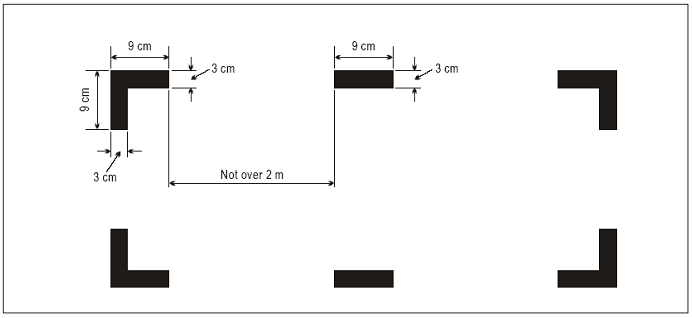
If areas of the fuselage suitable for break-in by rescue crews in an emergency are marked on an aeroplane, such areas shall be marked as shown below, and the colour of the markings shall be red or yellow and, if necessary, they shall be outlined in white to contrast with the background.
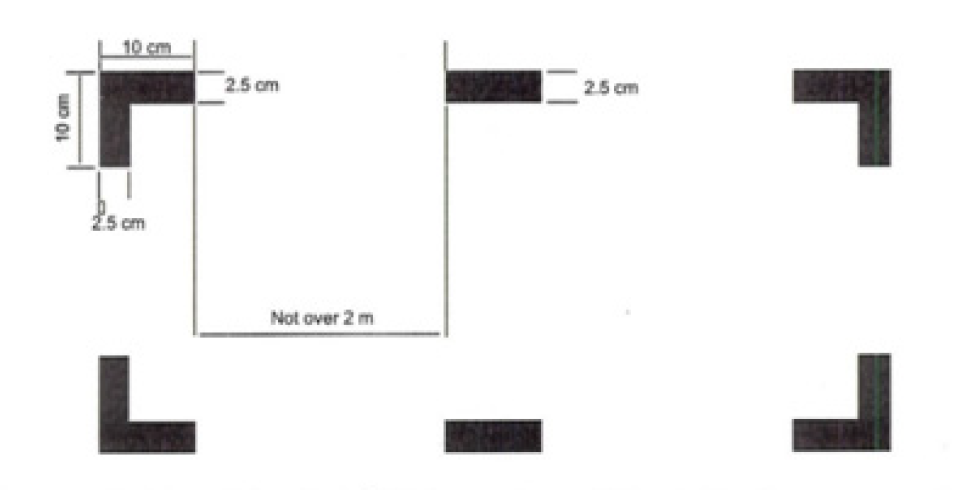
If the corner markings are more than 2 m apart, intermediate lines 9 cm x 3 cm shall be inserted so that there is no more than 2 m between adjacent markings.
- No person shall operate an aircraft that requires a cabin crew member unless it is equipped with at least one universal precaution kit.
- The contents of universal precaution kits to be carried shall comply with IS: 7.9.1.11.
- Each aircraft shall carry universal precaution kits in accordance with the following:
No person may operate a passenger flight in an aeroplane with 30 seats or more unless the aeroplane is equipped with an approved emergency medical kit for treatment of injuries or medical emergencies that might occur during flight time or in minor accidents.
The contents of emergency medical kits to be carried shall comply with IS: 7.9.1.12.
The medical kit shall be stored in a secure location.
The contents of emergency medical kits to be carried shall comply with IS: 7.9.1.12.
The medical kit shall be stored in a secure location.
All aircraft intended to be operated at altitudes requiring the use of supplemental oxygen shall be equipped with adequate oxygen storage and dispensing apparatus.
The oxygen apparatus, the minimum rate of oxygen flow, and the supply of oxygen shall meet applicable airworthiness standards for type certification in the transport category as specified by the Authority.
No person may operate an aircraft at altitudes above 10,000 feet unless it is equipped with oxygen masks, located so as to be within the immediate reach of flightcrew members while at their assigned duty station.
No person may operate a pressurized aeroplane at altitudes above 25,000 feet unless:
The oxygen apparatus, the minimum rate of oxygen flow, and the supply of oxygen shall meet applicable airworthiness standards for type certification in the transport category as specified by the Authority.
No person may operate an aircraft at altitudes above 10,000 feet unless it is equipped with oxygen masks, located so as to be within the immediate reach of flightcrew members while at their assigned duty station.
No person may operate a pressurized aeroplane at altitudes above 25,000 feet unless:
- Flightcrew member oxygen masks are available at the flight duty station and are of a quick donning type;
-
Sufficient spare outlets and masks and/or sufficient portable oxygen units with masks are distributed evenly throughout the cabin to ensure immediate availability of oxygen to each required cabin crew member regardless of his location at the time of cabin pressurisation failure
An oxygen-dispensing unit connected to oxygen supply terminals is installed so as to be immediately available to each occupant, wherever seated. The total number of dispensing units and outlets shall exceed the number of seats by at least 10%. The extra units are to be evenly distributed throughout the cabin.
The amount of supplemental oxygen for sustenance required for a particular operation shall be determined on the basis of flight altitudes and flight duration, consistent with the operating procedures established for each operation in the Operations Manual and with the routes to be flown, and with the emergency procedures specified in the Operations Manual.
The processto determine the amount of supplemental oxygen needed for non-pressurised and pressurised aircraft is contained in IS: 7.9.1.13.
No AOC holder may operate an aeroplane with a maximum certified takeoff mass exceeding 5700 kg. or having a maximum approved seating configuration of more than 19 seats unless—
The oxygen supply for PBE may be provided by the required supplemental oxygen system.
The PBE intended for flight crew use shall be conveniently located on the flight deck and be easily accessible for immediate use by each required flight crew member at their assigned duty station.
The PBE intended for cabin crew use shall be installed adjacent to each required cabin crew member duty station.
Easily accessible portable PBE shall be provided and located at or adjacent to the required hand fire extinguishers except that, where the fire extinguisher is located inside a cargo compartment, the PBE shall be stowed outside but adjacent to the entrance to that compartment.
The PBE while in use shall not prevent required communication.
- It has PBE to protect the eyes, nose and mouth of each flight crew member while on flight deck duty and to provide oxygen for a period of not less than 15 minutes; and
- It has sufficient portable PBE to protect the eyes, nose and mouth of all required cabin crew members and to provide breathing gas for a period of not less than 15 minutes.
The PBE intended for flight crew use shall be conveniently located on the flight deck and be easily accessible for immediate use by each required flight crew member at their assigned duty station.
The PBE intended for cabin crew use shall be installed adjacent to each required cabin crew member duty station.
Easily accessible portable PBE shall be provided and located at or adjacent to the required hand fire extinguishers except that, where the fire extinguisher is located inside a cargo compartment, the PBE shall be stowed outside but adjacent to the entrance to that compartment.
The PBE while in use shall not prevent required communication.
No AOC holder may conduct a passenger carrying operation in a pressurized aeroplane at altitudes above 25,000 feet, when a cabin crew member is required to be carried, unless it is equipped with—
The oxygen equipment provided shall be capable of generating a mass flow to each user of at least four litres per minute, STPD. Means may be provided to decrease the flow to not less than two litres per minutes, STPD, at any altitude.
Each person operating a passenger-carrying aeroplane shall have a portable battery-powered megaphone or megaphones readily accessible to the crew members assigned to direct emergency evacuation.
The number and location of megaphones required in paragraph (a) shall be determined as follows:
Note: The Authority may grant an exemption from the requirements of paragraph (b) if the Authority finds that a different location would be more useful for evacuation of persons during an emergency.
The number and location of megaphones required in paragraph (a) shall be determined as follows:
- On aeroplanes with a seating capacity of more than 60 and less than 100 passengers, one megaphone shall be located at the most rearward location in the passenger cabin where it would be readily accessible to a normal cabin crew member seat; and
- On aeroplanes with a seating capacity of more than 99 passengers, two megaphones in the passenger cabin on each aeroplane one installed at the forward end and the other at the most rearward location where it would be readily accessible to a normal cabin crew member seat.
- For aeroplanes with more than one passenger deck, in all cases when the total passenger seating configuration of a deck is more than 60, at least one megaphone is required on the deck.
Landplanes.
-
Landplanes shall carry the equipment prescribed in paragraph 2:
- When flying en-route over water beyond gliding distance from the shore;
- When flying over water at a distance of more than 93 km (50 NM) away from the shore for aircraft capable of maintaining safe altitude after the failure of one engine for twoengine aircraft and the failure of two engines for three or four-engine aircraft.; or
- When taking off or landing at an aerodrome where the (Authority) has determined the takeoff or approach path is so disposed over water that in the event of a mishap there would be the likelihood of a ditching.
- One life-jacket or equivalent flotation device equipped with a means of electric illumination shall be carried for each person on board, stowed in a position easily accessible from the seat or berth of the person for whose use it is provided.
- For all flights, seaplanes shall be equipped with the equipment prescribed in paragraph 2.
In addition to the equipment prescribed in § 7. 9.1.17 and § 7. 9.1.19 of this Part, lifesaving rafts in sufficient numbers to carry all persons on board shall be installed in:
Note: Both 14 CFR and JAR OPS 1 set the limit at 30 minutes or 100 NM away from land suitable for making an emergency landing.
An aircraft shall have lifesaving rafts with a sufficient capacity to carry all persons on board in the event of the loss of one raft of the largest capacity.
All lifesaving rafts shall be stowed so as to facilitate their ready use in an emergency.
Life rafts shall be equipped with the following life sustaining equipment—
In helicopters, life rafts which are not deployable by remote control and which have a mass of more than 40 kg shall be equipped with a means of mechanically assisted deployment.
Note: The ELT requirement in 7.9.1.18(d)(4) is an FAA requirement and not an ICAO requirement.
- Aeroplanes operated on long range over-water flights, and
- All other aeroplanes when they are operated over water away from land suitable for making an emergency landing at a distance of more than 185 km (100 NM) in the case of singleengine aeroplanes, and more than 370 km (200 NM) in the case of multi-engine aeroplanes capable of continuing flight with one engine inoperative.
All lifesaving rafts shall be stowed so as to facilitate their ready use in an emergency.
Life rafts shall be equipped with the following life sustaining equipment—
Note: The ELT requirement in 7.9.1.18(d)(4) is an FAA requirement and not an ICAO requirement.
All helicopters flying over water at a distance from land corresponding to more than 10 minutes at normal cruise speed in the case of performance Class 1 or 2 helicopters, or flying over water beyond auto-rotational or safe forced landing distance from land in the case of performance Class 3 helicopters, shall be fitted with a permanent or rapidly deployable means of floatation so as to ensure a safe ditching of the helicopter.
On all internal flights and on flights with single-engine and multi-engine aircraft which are not capable of maintaining the prescribed minimum safe altitude in the event of engine failure, shall comply with the provisions of ICAO Annex 7 Chapter 7.8 and for BES Islands Civil Aviation Regulations in The Netherlands, and the following emergency equipment shall be carried.